Evidence-based design. Reliable delivery.
LEARN MOREIn-situ testing forms the backbone of geotechnical site characterization in Casper, Wyoming, providing engineers and contractors with direct measurements of subsurface conditions without the disturbance inherent in laboratory sampling. This category encompasses a range of field investigation methods that evaluate soil and rock properties in their natural state, from strength and compressibility to density and permeability. In a region where expansive soils, shallow bedrock, and variable alluvial deposits define the landscape, relying solely on laboratory tests can lead to costly misinterpretations. In-situ methods bridge the gap between theoretical models and real-world behavior, ensuring that foundations, retaining walls, and earthworks perform as designed under local conditions.
Casper sits within the Wyoming Basin, a geological province characterized by interbedded sedimentary rocks—primarily sandstones, siltstones, and shales—overlain by Quaternary alluvium along the North Platte River and its tributaries. These near-surface soils often contain lenses of clay with high swell potential, collapsible silts, and poorly graded sands that can complicate construction. Seasonal freeze-thaw cycles and semi-arid moisture regimes further influence soil behavior, making field testing essential for capturing conditions that change with depth and weather. Without accurate in-situ data, projects risk differential settlement, slope instability, or foundation heave—problems that are both expensive and dangerous to remediate after construction.
In the United States, in-situ testing procedures are governed primarily by ASTM International standards, which are referenced in the International Building Code (IBC) adopted by the City of Casper. Key standards include ASTM D1586 for the Standard Penetration Test (SPT), ASTM D5778 for Cone Penetration Testing (CPT), and ASTM D1556 for the field density test (sand cone method). Wyoming-specific requirements often tie to the Wyoming Department of Transportation (WYDOT) specifications, particularly for roadway and infrastructure projects. Compliance with these standards ensures that data collected is defensible, repeatable, and suitable for design. Local geotechnical firms must also consider the Casper Area Metropolitan Planning Organization guidelines when testing within public right-of-way corridors.
Projects that demand in-situ testing in Casper range from residential subdivisions expanding into the foothills to commercial developments along the I-25 corridor and energy infrastructure supporting the Powder River Basin. Foundation design for multi-story buildings often requires field density test (sand cone method) to verify compaction of structural fill, while deep foundation analysis may rely on pressuremeter or dilatometer testing to assess bedrock bearing capacity. Roadway expansions, bridge replacements, and utility trench backfill all depend on rigorous field compaction control. Even smaller-scale projects like retaining walls and stormwater detention basins benefit from in-situ permeability tests that reflect actual hydraulic conductivity rather than laboratory estimates. The common thread is a need for reliable data that reduces uncertainty and prevents overdesign.
In-situ testing measures soil properties in their natural state without removing samples, preserving factors like stress conditions, moisture content, and structure. Laboratory testing requires extracting samples that may be disturbed during transport and preparation. In Casper, where sensitive silts and expansive clays are common, field tests like CPT and sand cone density provide more representative data for design while lab tests complement them with classification and strength parameters.
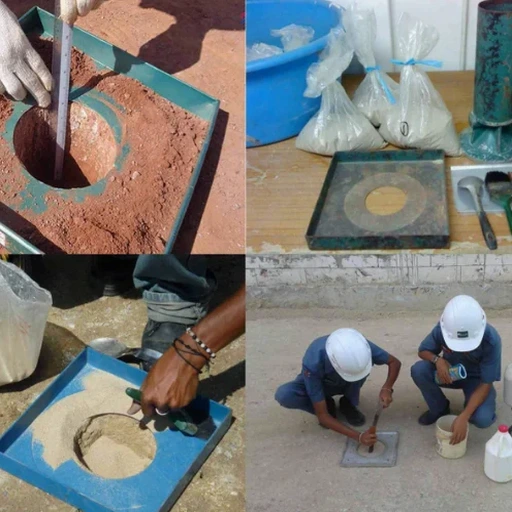
The sand cone density test (ASTM D1556) remains the most widely accepted method for field compaction verification in Casper. It directly measures in-place density and moisture content of compacted fill, allowing comparison with laboratory Proctor values. Nuclear density gauges are also used but require calibration and a radiation safety program. The choice depends on project specifications, soil type, and regulatory requirements from the City of Casper or WYDOT.
Depth capability varies by method and local geology. Standard Penetration Tests (SPT) routinely reach 50 to 100 feet in Casper's alluvial deposits, while Cone Penetration Testing (CPT) can exceed 100 feet in softer soils but may refuse on shallow sandstone bedrock. Pressuremeter and dilatometer tests are typically deployed at specific depths within boreholes. The variable bedrock topography in the Wyoming Basin often dictates the practical limit of any given test.
Key ASTM standards include D1586 for Standard Penetration Test, D5778 for Cone Penetration Testing, D1556 for sand cone density, D4719 for pressuremeter testing, and D6635 for dilatometer testing. The City of Casper adopts these through the International Building Code, while WYDOT projects reference supplemental specifications. Geotechnical reports must clearly state which standards were followed to ensure regulatory compliance and data reliability.
We serve projects across Casper Wyoming and surrounding areas.