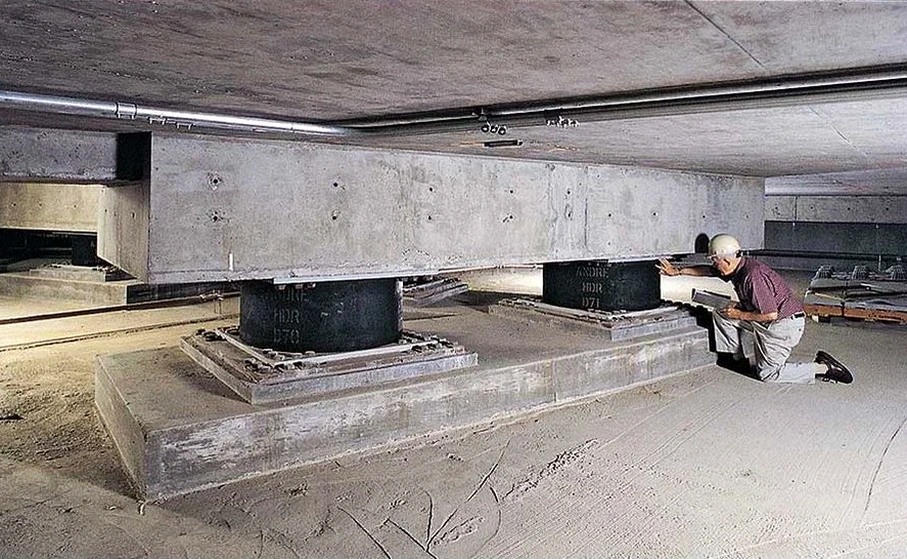
A three-story medical office building near Second Street had a problem. The structural drawings called for a fixed-base concrete frame, but the geotechnical report showed 35 feet of sandy silt over weathered shale—and Casper sits in Seismic Design Category C with site class D amplification. The owner wanted uninterrupted hospital operations after a design-level event. That meant base isolation. We modeled the isolators using eleven ground motion pairs matched to the Casper uniform hazard spectrum. The isolation period landed at 2.8 seconds, well above the site’s 0.6-second spectral peak. For projects on the Casper alluvial plain, we often pair base isolation design with seismic microzonation studies to refine site coefficients beyond the ASCE 7 defaults.
In Casper, the temperature sensitivity of isolation bearings requires prototype testing across a 100-degree Fahrenheit range—not just ambient.