GEOTECHNICAL ENGINEERING
CASPER WYOMING
HomeFoundationsPile foundation design

Pile Foundation Design in Casper Wyoming: Deep Foundations for High-Wind and Expansive Soils

Evidence-based design. Reliable delivery.

LEARN MORE

IBC Chapter 18 and ASCE 7-22 set the baseline, but pile foundation design in Casper Wyoming demands more than just code compliance. The city sits at 5,150 feet on a high plains terrace where the Cretaceous shale and claystone bedrock weathers into moderately expansive soils. Seasonal moisture swings here open cracks in slab-on-grade homes every spring. We see it constantly. Deep foundations bypass that active zone entirely. Bearing loads transfer down to competent shale or sandstone, often between 25 and 45 feet. Wind governs lateral design on almost every project east of the Casper Arch. The ASCE 7 wind speeds for this region push past 115 mph ultimate, so pile groups and single deep elements need real moment resistance. A well-planned CPT test ahead of design gives continuous tip resistance and sleeve friction data through the weathered overburden, which is far more useful here than split-spoon blow counts alone.

In Casper's high plains, pile foundation design isn't just about bearing capacity — it's about controlling lateral drift under 115 mph winds and isolating structures from expansive near-surface claystone.
Our service areas

How we work

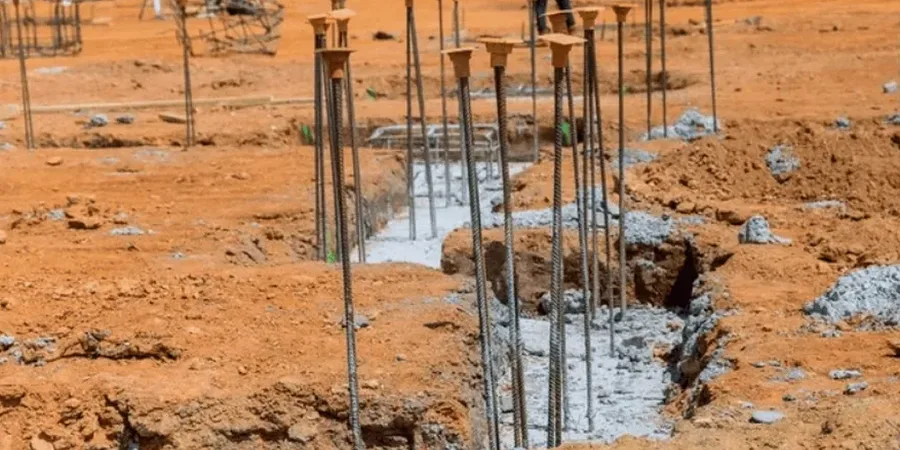
A four-story medical office building near the Wyoming Medical Center needed pile support after test borings hit fat clay with PI values above 35. The upper 18 feet was stiff, jointed claystone swelling under the slightest moisture change. Steel H-piles driven to refusal on the unweathered Frontier Formation sandstone solved it. We designed the pile cap group for axial service loads of 90 kips per pile, with lateral deflection limits under 0.25 inches at grade due to sensitive imaging equipment inside. Frost depth in Natrona County is 48 inches minimum, so pile caps were set below that line. The Casper building department reviews deep foundation submittals against the 2018 IBC with local amendments, and they expect a geotechnical narrative signed by the engineer of record. We document every assumption. Pile capacity verification used CAPWAP analysis on two indicator piles, correlated back to the boring logs and lab triaxial data from undisturbed Shelby tube samples. That combination of dynamic testing and lab-calibrated soil parameters is standard practice for us when the site stratigraphy varies across the lot.
Pile Foundation Design in Casper Wyoming: Deep Foundations for High-Wind and Expansive Soils
Technical reference — Casper Wyoming

Site-specific factors

Casper grew along the railroad and the North Platte River corridor, then spread south and west onto the terraces during the oil booms of the 1970s and early 80s. That rapid expansion pushed subdivisions onto expansive claystone that earlier builders avoided. Today, many of those homes show classic distress: sticking doors, cracked drywall, and separated foundation walls. Commercial developers learned the lesson fast. The newer retail and medical buildings almost universally specify deep foundations or heavily reinforced grade beams on drilled piers. Another risk that gets less attention is the wind-driven lateral load on exposed pile caps in hillside construction along Casper Mountain Road. Unbraced pile lengths above grade, even three or four feet, can amplify moment demands significantly. Our designs account for that exposed length explicitly, using p-y analysis for the near-surface weathered zone where lateral resistance is poorest. Liquefaction is not a concern here — the groundwater table is deep, and granular alluvium is limited to narrow river corridors — but expansive soil swell pressure can exceed 5,000 psf in wet years, enough to heave lightly loaded foundations.

Need a geotechnical assessment?

Reply within 24h.

Email: contact@geotechnicalengineering1.org

Applicable standards

IBC 2018 (adopted by City of Casper, with local amendments), ASCE 7-22 Minimum Design Loads for Buildings and Other Structures, ASTM D1586 Standard Test Method for SPT and Split-Barrel Sampling, ASTM D4767 Standard Test Method for Consolidated Undrained Triaxial Compression Test, FHWA GEC 10 Drilled Shafts: Construction Procedures and LRFD Design Methods

Technical parameters

ParameterTypical value
Typical pile depth to competent rock25–45 ft below grade
Predominant bedrockFrontier Formation sandstone, Mowry Shale
Frost depth (Natrona County)48 inches per IBC Table 1809.5
ASCE 7-22 ultimate wind speed115–120 mph (Risk Category II)
Seismic design categoryB (site class C/D, per IBC 1613)
Expansive soil potentialModerate to high (PI 25–40+)
Common pile typeDriven steel H-piles, drilled cast-in-place
Lateral load test acceptanceDeflection < 0.25 in at design load

Common questions

What does a pile foundation design package cost in the Casper area?
How do you address expansive claystone in pile design for Casper sites?

We isolate the structure from the active zone by extending piles through the weathered claystone to unweathered bedrock. Where grade beams are used, we specify void forms beneath them to accommodate swell. The design assumes zero skin friction contribution from the expansive upper layer for uplift resistance.

Which building code governs deep foundation design in Natrona County?

The City of Casper has adopted the 2018 International Building Code with local amendments. Chapter 18 covers deep foundations. We also reference ASCE 7-22 for load combinations and wind speeds, and FHWA GEC 10 for drilled shaft construction methods.

How long does design and approval take for a pile foundation project here?

From mobilizing the drill rig to delivering a sealed submittal, plan four to six weeks for a typical Casper project. Subsurface investigation takes one to two weeks, lab testing runs concurrently, and the engineering analysis and drafting fill the remaining time. City plan review adds another two to three weeks depending on their current workload.

Location and service area

We serve projects across Casper Wyoming and surrounding areas.

View larger map