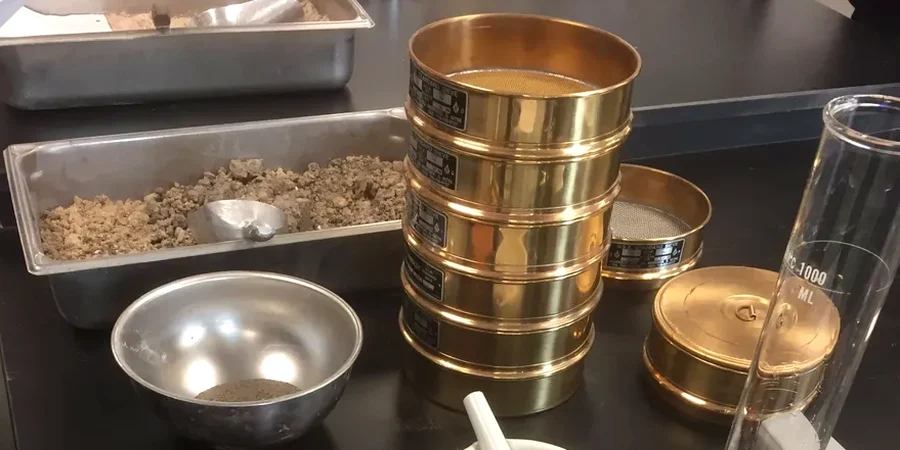
Laboratory testing forms the backbone of geotechnical engineering in Casper, Wyoming, providing the critical data needed to design safe and economical foundations, retaining structures, and earthworks. The category encompasses a suite of standardized tests performed on soil and rock samples recovered from the field, transforming physical specimens into quantifiable engineering parameters. In a region where subsurface conditions can shift dramatically within a single project site, relying on visual classification alone is an unacceptable risk. A comprehensive laboratory program deciphers the engineering story of the soil, revealing its strength, compressibility, permeability, and volume-change potential under load.
The geological context of Casper demands this rigorous approach. The city sits at the foot of Casper Mountain, straddling the transition between the High Plains and the Laramie Range. Surficial geology is dominated by Quaternary alluvial deposits along the North Platte River corridor, flanked by terraces of older gravels and expansive Cretaceous shales like the Steele and Pierre formations. These shales are notorious for their swelling behavior when wetted, a primary driver of foundation distress locally. An accurate grain size analysis (sieve + hydrometer) is often the first step in identifying a potentially expansive fine-grained soil, distinguishing a problematic fat clay from a more stable lean clay or silt.
Adherence to national standards is the non-negotiable rule for all laboratory procedures. The American Society for Testing and Materials (ASTM) provides the governing protocols that ensure consistency, repeatability, and legal defensibility of results. A geotechnical report for any Casper project, from a municipal bridge to a commercial warehouse, will reference a chain of ASTM designations. Common standards include ASTM D422 for particle-size analysis, ASTM D4318 for Atterberg limits, and ASTM D2435 for one-dimensional consolidation. These standards dictate everything from sample preparation to equipment calibration, creating a common language between the laboratory, the geotechnical engineer, and the structural designer who will ultimately rely on the data.
The types of projects in Casper that demand a full laboratory investigation are diverse. Any structure imparting significant load, or any development where earthwork is substantial, requires it. This includes commercial buildings in the expanding east-side developments, public infrastructure like the Casper-Natrona County International Airport expansions, and energy-sector facilities throughout the Powder River Basin. A critical, yet sometimes overlooked, parameter for these sites is hydraulic conductivity. For projects involving stormwater infiltration, earthen dams, or containment berms, an in-situ permeability test, complemented by lab permeability on a representative sample, quantifies how water will move through the soil, directly influencing drainage design and environmental compliance.
Field visual classification is subjective and cannot quantify critical engineering properties like shear strength, compressibility, or expansion potential. Laboratory testing under ASTM standards provides the measured, numerical values required for analytical design. In Casper's variable geology, a soil that looks like a stable clay in the field may prove to be a highly expansive shale when subjected to a precise Atterberg limits test, a distinction vital for foundation design.
A standard program references numerous ASTM standards. Key ones include ASTM D422 for particle-size analysis, D4318 for Atterberg limits, D698 and D1557 for compaction characteristics, D2435 for consolidation, and D3080 for direct shear strength. The specific standards selected depend on the project requirements, but all ensure a consistent, legally defensible methodology that is the foundation of every geotechnical report in the United States.
The duration depends entirely on the test suite's complexity. Basic classification tests like moisture content, grain size analysis, and Atterberg limits can be completed within a few days. However, tests requiring time-dependent processes, such as a one-dimensional consolidation test on a saturated clay sample, may take one to two weeks or longer to complete all loading increments. The project schedule should account for these physical time constraints.
A disturbed sample preserves only the soil's constituent particles and is suitable for classification, compaction, and grain size analysis. An undisturbed sample, typically obtained using a thin-walled Shelby tube, aims to preserve the soil's in-situ structure, density, and moisture content. This is essential for strength and consolidation tests. In Casper's stiff shales, obtaining a truly undisturbed sample is challenging and requires careful drilling techniques.
We serve projects across Casper Wyoming and surrounding areas.