GEOTECHNICAL ENGINEERING
CASPER WYOMING
HomeInvestigationSPT (Standard Penetration Test)

SPT (Standard Penetration Test) in Casper Wyoming

Evidence-based design. Reliable delivery.

LEARN MORE

ASTM D1586-18 governs SPT execution across the United States, but in Casper Wyoming the standard takes on added weight. The city sits at 5,120 feet elevation on the North Platte River, underlain by Quaternary alluvium, terrace gravels, and interbedded clays that shift dramatically over short distances. Contractors unfamiliar with the basin’s depositional history often misinterpret refusal depth or assume uniform bearing, only to encounter bouldery lenses or groundwater at 12 to 18 feet below grade. A properly hammered split-spoon sampler with calibrated energy delivers N-values that feed directly into IBC Chapter 18 bearing-capacity calculations. When shallow refusal suggests bedrock, but the profile is actually cemented gravel — common on Casper’s west side near the river terraces — the SPT log prevents overconservative foundation sizing. For sites near Alcova or along the I-25 corridor where soil variability increases, we often pair the SPT program with a CPT investigation to capture continuous tip resistance and pore-pressure data across transitions that the split-spoon might miss.

Corrected N60 values from Casper’s alluvial terraces often reveal 25–40% higher liquefaction resistance than raw field blows suggest when energy calibration is applied.
Our service areas

How we work

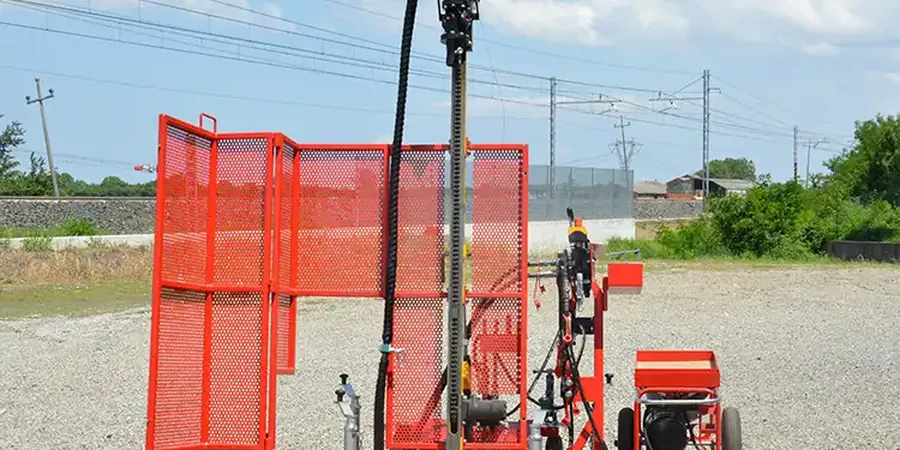
A recurring mistake in central Wyoming is treating SPT blow counts as absolute values without applying the corrections that ASTM D1586 mandates. Hammer energy ratio, rod length, borehole diameter, and sampler liner type all influence the raw N-value, and ignoring these factors in Casper’s mixed alluvial profiles can shift allowable bearing pressure by 30 percent or more. We run automatic trip hammers with energy monitoring on every rig, log the actual ERi, and report corrected N60 values alongside the field blows. The procedure follows a strict sequence: advance 6-inch-diameter mud-rotary borehole to test depth, clean the bottom, drive the 2-inch split spoon 18 inches in three 6-inch increments, and record the sum of blows for the second and third increments as the standard N-value. Samples recovered from each drive undergo visual classification per ASTM D2488 in the field, then subset for laboratory grain-size analysis. When cohesionless soils dominate — typical of the wind-deposited sands east of downtown — the corrected N60 feeds directly into liquefaction triggering procedures per Youd and Idriss (2001) and the NCEER workshop recommendations.
In Casper’s finer-grained terrace deposits, SPT samples also provide material for Atterberg limits and pocket penetrometer readings that bracket undrained shear strength. The combination of field blow counts and lab index properties supports settlement estimates under spread footings and identifies compressible layers that could trigger differential movement. For sites requiring deeper bearing evaluation, the SPT refusal criterion — 50 blows in any 6-inch increment — flags transitions to very dense gravel or shale bedrock that may need rock coring for confirmation.
SPT (Standard Penetration Test) in Casper Wyoming
Technical reference — Casper Wyoming

Site-specific factors

Casper lies in Seismic Design Category C per ASCE 7-22, with mapped short-period spectral accelerations around 0.25g to 0.35g depending on site class. The shallow groundwater table along the North Platte floodplain — commonly encountered between 10 and 20 feet depth — combined with loose-to-medium-dense sands in the upper 30 feet creates conditions that demand liquefaction screening under IBC Section 1803.5.12. A single SPT boring without energy correction can underestimate cyclic resistance ratio by 15–20 percent, leading to a false sense of security about excess pore-pressure generation during a design-level earthquake. The Casper area’s wind-deposited silt lenses add another variable: these low-plasticity soils can exhibit cyclic softening behavior that standard SPT-based liquefaction charts do not capture well. When fines content exceeds 35 percent in the split-spoon samples, we supplement the SPT data with Atterberg limits to differentiate truly non-liquefiable plastic silts from sand-silt mixtures still susceptible to strength loss. The corrected N60 profile also feeds site-class determination per ASCE 7 Table 20.3-1, which directly influences the seismic design forces used by the structural engineer.

Need a geotechnical assessment?

Reply within 24h.

Email: contact@geotechnicalengineering1.org

Applicable standards

ASTM D1586-18: Standard Test Method for Standard Penetration Test (SPT) and Split-Barrel Sampling of Soils, ASTM D2487-17: Standard Practice for Classification of Soils for Engineering Purposes, IBC 2021 Section 1803: Geotechnical Investigations, ASCE 7-22 Chapter 20: Site Classification Procedure, NCEER (1997/2001): Liquefaction Resistance of Soils — Summary Report

Technical parameters

ParameterTypical value
Hammer typeAutomatic trip, safety hammer per ASTM D1586
Energy ratio (ERi)Measured via strain-gauge, typically 55–75%
Borehole diameter6-inch (152 mm) mud-rotary or hollow-stem auger
SamplerStandard 2-inch O.D. split spoon, 24-inch length
Test intervalEvery 5 ft or at stratum change per IBC 1803.5
N60 correctionN60 = N × (ERi/60) × rod-length factor
Liquefaction analysisNCEER method, Youd-Idriss (2001) triggering curves
Reporting standardASTM D1586-18 with corrected blow count logs and soil descriptions

Common questions

What depth do SPT borings typically reach in Casper Wyoming?

Most investigation programs extend to 30 to 50 feet below grade for conventional spread-footing structures, but sites requiring liquefaction analysis under IBC Section 1803.5.12 push to 60 feet or practical refusal. The actual termination depth depends on the foundation load, the depth to dense gravel or shale bedrock, and whether groundwater is encountered within the zone of influence. For deep foundation alternatives such as driven piles, borings continue until competent bearing material is confirmed over a minimum thickness.

How much does an SPT investigation cost in the Casper area?
What is the difference between raw N-values and corrected N60?

Raw N-values are the field blow counts recorded during the SPT without adjustment for hammer energy, rod length, borehole diameter, or sampler configuration. Corrected N60 normalizes the field blows to a reference hammer energy ratio of 60 percent, which is the basis for most empirical correlations used in bearing capacity, settlement, and liquefaction analyses. In Casper’s alluvial soils, the correction factor commonly falls between 0.75 and 1.20 depending on the hammer system and test depth. Reporting only raw values leads to inconsistent design parameters between different drilling contractors.

Location and service area

We serve projects across Casper Wyoming and surrounding areas.

View larger map