GEOTECHNICAL ENGINEERING
CASPER WYOMING
HomeLaboratoryTriaxial test

Triaxial Test for Soil & Rock in Casper Wyoming

Evidence-based design. Reliable delivery.

LEARN MORE

Casper sits at 5,150 feet on the high plains, where freeze-thaw cycles chew through weak rock and expansive clay shales create headaches for engineers. Winter temperatures here routinely drop to -20°F, and summer brings afternoon thunderstorms that saturate the near-surface soils in a matter of minutes. That rapid moisture swing changes everything underground. A triaxial test becomes the only reliable way to measure how Casper’s native soils behave when both vertical load and pore water pressure climb at the same time. We run these tests in our accredited lab following ASTM D2850 for unconsolidated-undrained conditions and ASTM D4767 when the project calls for consolidated-undrained parameters with pore pressure measurement. For projects near Casper Mountain or along the North Platte River, where the stratigraphy shifts between weathered sandstone and fat clay, the atterberg limits help us classify the material before the triaxial cell even gets set up.

A triaxial test does not predict failure. It reproduces the exact stress path the soil will see under the foundation, so the engineer knows the margin before failure.
Our service areas

How we work

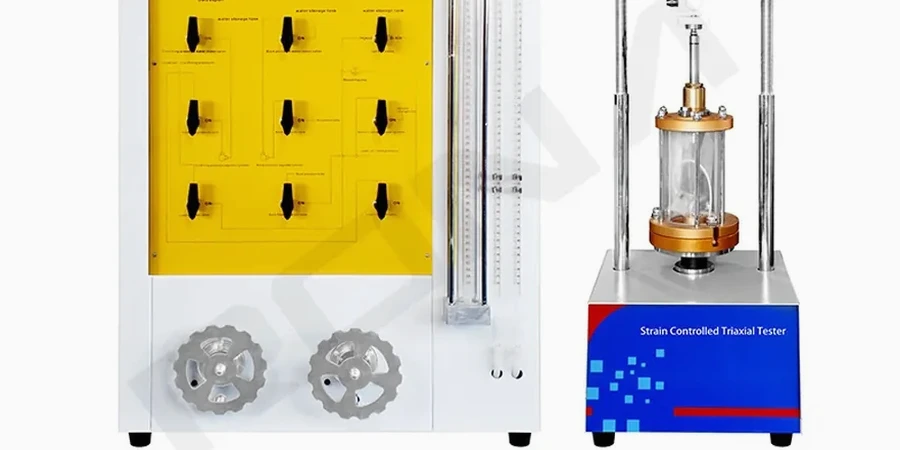
The most common mistake we see on Casper jobs is a consultant running unconfined compression on silty clay and calling it a day. That test ignores confining pressure. At 20-foot depth under a commercial slab on Second Street, the soil is not unconfined—it is squeezed from all sides. A triaxial test replicates that stress state. We trim the specimen, saturate it under back pressure, and shear it at a controlled strain rate while measuring deviator stress and excess pore pressure. The output is not just a single number. We deliver the Mohr-Coulomb envelope, effective cohesion c', and effective friction angle φ'. Those three values feed directly into bearing capacity equations, slope stability models, and retaining wall design. In Casper’s older neighborhoods like North Casper, where homes sit on Cretaceous shale, we often run three specimens at different cell pressures to bracket the failure envelope. That envelope tells the structural engineer exactly how much bearing capacity is left before the foundation punches through. For shallow groundwater conditions near the river, we pair the test with in-situ permeability measurements to understand how fast the soil drains during shear.
Triaxial Test for Soil & Rock in Casper Wyoming
Technical reference — Casper Wyoming

Site-specific factors

Casper sits in Seismic Design Category C per IBC, and while Wyoming is not California, the 1984 earthquake swarm near Casper Mountain registered a magnitude 5.0. That is enough to trigger undrained failure in saturated silts. A foundation designed with drained parameters only—no triaxial CU data—will underestimate pore pressure buildup during cyclic loading. We have seen old commercial buildings along CY Avenue develop settlement cracks because the original geotech report used SPT blow counts and textbook friction angles instead of site-specific triaxial results. The cost difference between a triaxial test and a forensic investigation after the slab cracks is not even close. For flexible pavement design on Casper’s expanding arterial roads, the resilient modulus from repeated-load triaxial testing per AASHTO T307 gives the pavement engineer a number they can actually plug into the MEPDG software.

Need a geotechnical assessment?

Reply within 24h.

Email: contact@geotechnicalengineering1.org

Applicable standards

ASTM D2850, ASTM D4767, AASHTO T307

Technical parameters

ParameterTypical value
Test standard (cohesive soils)ASTM D4767 (CU with pore pressure)
Test standard (rapid loading)ASTM D2850 (UU triaxial)
Specimen diameter1.4 to 2.8 in (typical for Casper shale)
Back pressure saturationSkempton B-value ≥ 0.95
Effective cohesion c'0 to 400 psf (Casper clay typical range)
Effective friction angle φ'18° to 34° depending on plasticity
Strain rate (CU test)0.005 to 0.02 in/min
Failure criterion reportedMax deviator stress or 20% strain

Common questions

What is the typical turnaround time for a triaxial test on Casper clay?

A standard CU triaxial set with three specimens takes 7 to 10 business days from sample receipt. The saturation phase on Casper's stiff Cretaceous shale can take 48 hours alone to reach a B-value above 0.95. We do not rush saturation—air in the pore water gives you a false effective stress path.

How much does a triaxial test program cost for a small commercial lot in Casper?
Do I need CU or UU triaxial for my Casper foundation design?

It depends on loading rate and drainage. For a fast-track slab-on-grade where the clay cannot drain during construction, UU per ASTM D2850 is appropriate and gives you undrained shear strength Su. For a retaining wall or slope where the soil will eventually drain, you need CU with pore pressure measurement to get effective stress parameters c' and φ'. We can help you decide after reviewing the boring logs.

Can you test Casper sandstone in the triaxial cell?

Yes. We run triaxial tests on weak sandstone cores from the Casper Formation using a high-pressure cell up to 10,000 psi confining pressure. The procedure follows ASTM D7012 for intact rock, and we report the Mohr-Coulomb envelope and the Hoek-Brown parameters if the project requires them.

Location and service area

We serve projects across Casper Wyoming and surrounding areas.

View larger map